 Beefy
Beefy Automated DeFi Yield and Smart Contract Risk
Beefy automatically reinvests DeFi rewards through smart contract strategies across multiple blockchains, reducing the repeated transactions involved in yield farming. Its main products accept assets into vaults that deploy funds and compound earnings. Concentrated liquidity products also manage liquidity positions, while BIFI provides governance participation. The practical choice starts with the asset exposure you want to retain. Automation changes how earnings are handled; token prices, underlying protocols, and contract failures can still reduce your position’s value.
- updatedOn this page
A deposit that reaches the intended position
Compatible assets and spending permission
A deposit requires a compatible wallet, the correct blockchain, an accepted asset, and enough native currency for transaction fees. An ordinary vault accepts its designated deposit token, which may represent an existing liquidity pool position. Where supported, Zap combines asset conversion and vault entry. Availability varies by product and input token. Review the proposed conversion before granting spending permission, including the amount that the contract may spend. Approval authorizes access to tokens; it doesn’t establish a vault position.
A time-sensitive deposit example
Consider a hypothetical deposit with an accepted token, sufficient transaction funds, and a need to finish before making another transfer. The selected vault supports a Zap route. Assume its initial quote is acceptable and any required spending approval has succeeded. The next operation is the deposit transaction. Its status and resulting position establish whether the deposit completed; the displayed annual yield says nothing about completion.
Now change one hypothetical input: the swap quote deteriorates before the deposit is submitted. The same starting token amount buys less of the vault’s deposit asset, reducing the expected position. Reviewing the replacement quote is necessary before signing. An earlier acceptable quote doesn’t establish that the changed conversion remains acceptable.
If the transaction succeeds and the corresponding vault position appears, the deposit is complete. If the transaction remains pending, completion hasn’t been established. A failed transaction invalidates the expected position change and requires inspection before another attempt. Neither a successful approval nor a wallet’s submission message proves that assets reached the vault. You can’t count on a pending deposit finishing before the planned transfer.
Zap combines several operations, so its final position can differ from the quote within the transaction’s permitted limits.
What does Beefy automate after a deposit?
Beefy automates the operations defined by the selected strategy, including reward harvesting and reinvestment or concentrated liquidity management.
Reinvestment through a farming strategy
A farming strategy collects rewards from an underlying protocol and converts them into additional deposit assets. Those assets return to the position, allowing subsequent earnings to accrue on a larger asset balance. Shared execution reduces the need for each depositor to submit separate harvesting and reinvestment transactions. The strategy’s reward source matters: changing incentives or declining activity can reduce earnings even when the contracts operate correctly.
Management of concentrated liquidity
Beefy’s CLM products directly manage concentrated liquidity positions. Concentrated liquidity supplies assets within a price range. Range management addresses the maintenance that these positions require, but doesn’t eliminate changing asset proportions or impermanent loss. CLM Pools and CLM Vaults also handle rewards differently: pool incentives can remain claimable, whereas a vault built on the product can reinvest those incentives. The choice affects whether those incentives remain claimable or increase the underlying position.
The inputs behind the return
Annualized yield and realized value
Annual percentage yield, or APY, expresses a rate that includes compounding assumptions. Annual percentage rate, or APR, expresses a rate without that compounding effect. A displayed annualized figure projects earning conditions; it doesn’t establish the amount that a deposit will earn over the coming year. Reward rates, pool activity, deposited capital, and strategy behavior can change. Separate growth in deposit assets from changes in their market value. More units can still be worth less.
Performance fees and transaction costs
Beefy’s vault performance fees take a share of harvested rewards. Those fees help fund protocol operations and incentives. Their effect is included in the displayed vault yield calculation, so subtracting the same performance fee again would double-count it. A withdrawal charge may apply to the selected vault. Network transaction costs and any conversion costs also affect the final outcome, particularly when entering and leaving repeatedly. Assess the product’s applicable fees rather than treating one published percentage as universal.
Which risks remain when the strategy runs correctly?
Asset losses, underlying protocol failures, and liquidity exposure remain possible even when Beefy’s automation executes its intended operations correctly. A liquidity position can underperform holding its component assets because their relative prices change. That difference is commonly called impermanent loss. A single-asset position avoids the paired liquidity mechanism, but retains the risks of its token and yield source. Stablecoin exposure also relies on the token maintaining its intended value.
A smart contract failure can leave deposited assets stolen or unavailable for withdrawal. The relevant contracts include both Beefy’s strategy and the underlying platforms that it uses. Audits and product risk checks help identify weaknesses; they don’t insure deposits. The Risk Checklist describes particular checks, rather than certifying every aspect of a product. A correlated-asset classification concerns the relationship between assets, for example, and doesn’t establish that either asset will preserve its value.
Withdrawal assets and recovery limits
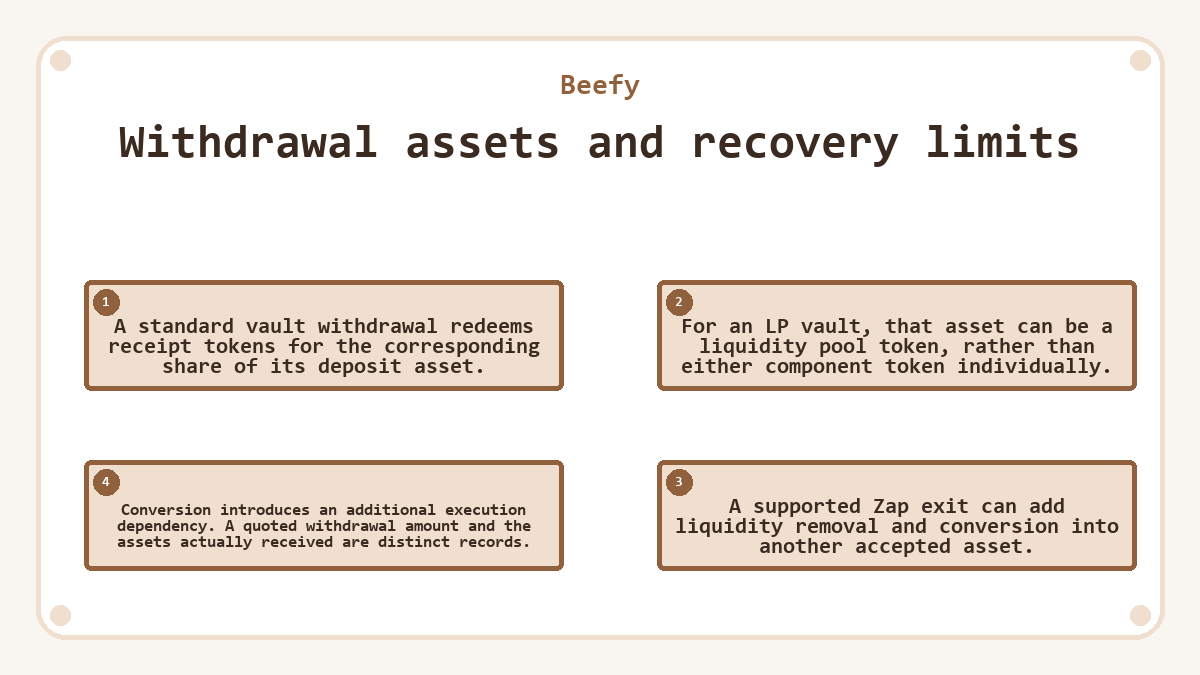
A standard vault withdrawal redeems receipt tokens for the corresponding share of its deposit asset. For an LP vault, that asset can be a liquidity pool token, rather than either component token individually. A supported Zap exit can add liquidity removal and conversion into another accepted asset. Conversion introduces an additional execution dependency. A quoted withdrawal amount and the assets actually received are distinct records.
Ordinary vaults don’t impose a fixed deposit lockup, but withdrawal execution requires functioning contracts and available underlying assets. A website display problem is different from a strategy that cannot release funds. Direct contract interaction doesn’t bypass a broken underlying protocol. Receipt tokens also carry the withdrawal claim: transferring them transfers that claim.
BIFI participation and alternatives to compounding
BIFI is the governance token, with voting power connected to token holdings. Its governance role differs from the exposure obtained through an ordinary asset vault. Governance participants influence matters including protocol funding and fee policy. Separate incentive programs accept BIFI deposits and distribute a portion of protocol revenue; simply holding the token isn’t the same as participating in those programs.
Direct participation in an underlying farm leaves harvesting and reward handling with the depositor. That can suit a task that requires retaining reward tokens instead of selling them for reinvestment. It also requires managing the associated transactions. Holding assets outside a farming position removes that position’s strategy exposure, while retaining the assets’ market risk.
Choose whether to compound rewards into the deposit asset or receive them separately, and whether you want concentrated liquidity exposure. The next decision is whether the selected strategy’s asset mix and withdrawal path fit that purpose.
Frequently asked questions about Beefy
Do I need BIFI to deposit another asset into Beefy?
An ordinary asset vault requires its accepted deposit asset, rather than BIFI ownership. BIFI is needed for products and governance activities that specifically use it. Network transaction fees require the relevant blockchain’s native currency. Buying the governance token doesn’t substitute for the token that a selected vault accepts.
Why doesn’t my mooToken balance increase after a harvest?
A standard vault can compound earnings without increasing the number of mooTokens in your wallet. Each receipt represents a share of the vault, so successful reinvestment increases the underlying deposit assets attributable to that share. The receipt balance and redeemable asset balance measure different things. An unchanged receipt count alone doesn’t establish that compounding stopped.
When a Beefy Boost ends, are my receipt tokens returned automatically?
Receipt tokens staked in a Boost require a manual unstaking transaction after the Boost ends. The incentive period ending doesn’t automatically return them to your wallet. Boost rewards are separate from the ordinary earnings of the underlying vault, which continues operating under its own strategy. Ending the extra incentive program doesn’t itself redeem the vault position.
Does moving mooTokens to a hardware wallet remove the vault’s contract risk?
Moving mooTokens to a hardware wallet changes how you protect control of the receipt tokens, while the deposited assets remain exposed to the vault and its strategy. The hardware wallet doesn’t withdraw those assets or repair an underlying contract failure. Whoever controls the receipt tokens controls the associated redemption claim.
Why can a vault deposit consume more gas than a simple token transfer?
A vault deposit may execute strategy operations as well as transfer tokens. Some strategies harvest on deposit, collecting and reinvesting pending rewards during the transaction. Those additional contract calls increase the work that the blockchain must execute. The applicable network conditions and selected strategy determine the transaction cost; a simple transfer isn’t an equivalent operation.